Quasi-Judicial Proceedings Must Remain Formal: Allahabad HC Quashes GST Order for Breach of Natural Justice
Quasi-Judicial Proceedings Must Remain Formal: Allahabad HC Quashes GST Order for Breach of Natural Justice
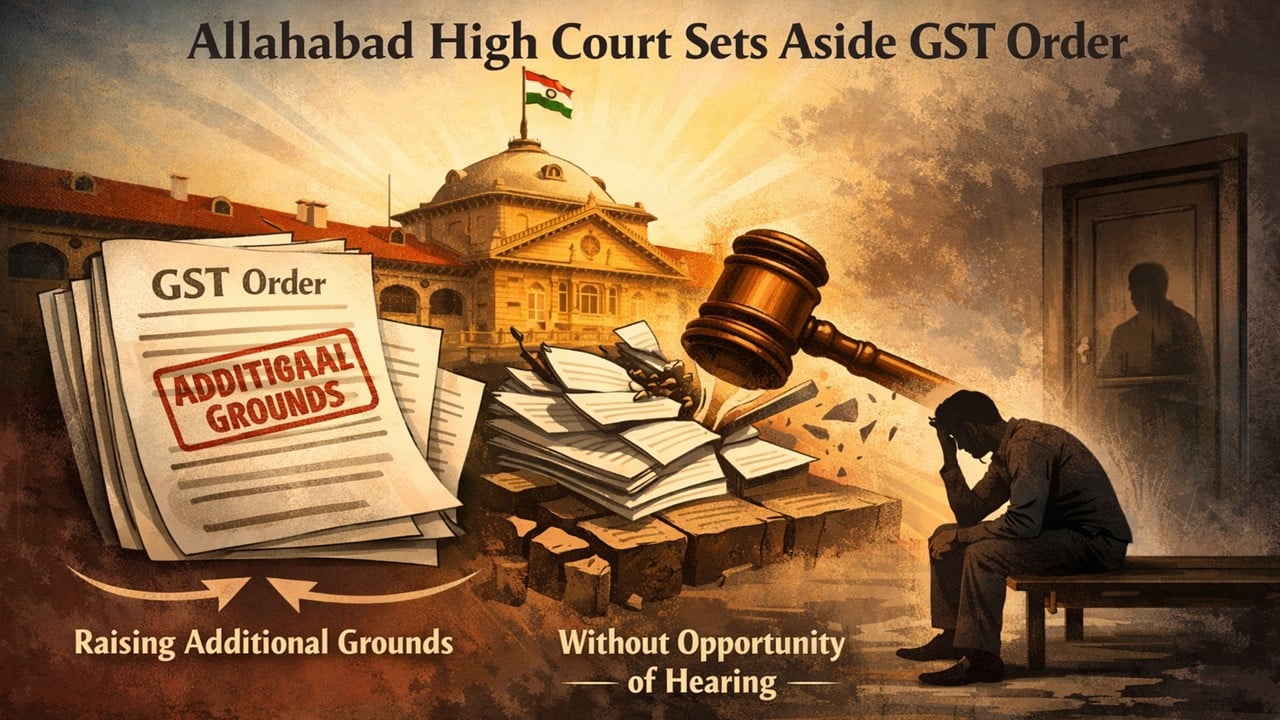
The Allahabad High Court set aside a GST order against the company, referencing a violation of the principles of natural justice. The court held that the additional grounds in the impugned order were raised without giving the petitioner a proper opportunity of hearing.
The writ petition was filed by Dell International Services India Private Limited against the State of U.P. and another, challenging an order dated December 30, 2025, passed by the GST authorities under Section 73 of the UPGST Act 2017.
During the hearing of the case, the petition emphasised the violation of the principles of natural justice. The petitioner claimed that initially, it was issued with three notices dated July 28, 2025; September 27, 2025; and December 22, 2025, for which the petitioner had timely responded and also appeared at the hearings on the dates scheduled by the GST authorities in these notices. The petitioner further claimed that it had furnished all the relevant documents explaining the claims made by it in the response to these notices.
However, the petitioner claimed that no queries were raised during that hearing and no further date was fixed. Despite this, the adjudicating authority suddenly issued the final impugned order dated December 30, 2025, confirming the tax demand proposed in the notices. The petitioner further flagged that the impugned order mentioned some additional grounds that were not discussed in earlier issued notices. The petitioner argued that this is not permitted under the law since they were not even given a chance to explain these additional grounds.
Another major concern raised before the court was that the adjudicating authority relied on a telephonic conversation with the petitioner’s representative to clarify doubts. The court observed that such informal communication is not appropriate in formal quasi-judicial proceedings because it reduces transparency and procedural fairness.
The judgement reads, “A strong objection has been raised as to the manner in which the proceeding has been conducted and concluded inasmuch as the impugned order itself records that on certain doubts arising with the adjudicating authority about the explanation furnished by the petitioner, he spoke to the authorised representative of the petitioner on the telephone/doorbhash.‘ That procedure adopted by the adjudicator is impermissible in law. It introduces unacceptable informality and therefore procedural subjectivity and dilutes transparency of procedure in the otherwise formal quasi-judicial proceeding without sanction of the law.”
When the High Court analysed the facts of the case, it observed a violation of the principles of natural justice, as the petitioner was not given the opportunity to present its side on additional grounds. Considering the same, the court set aside the impugned order dated December 30, 2025, and sent the matter back to the concerned authorities for fresh consideration after giving the petitioner a proper hearing. A time limit till March 31, 2026, has been given to the GST authorities to make a fresh decision on the present case.